

AMEST 2027 & IMS 2027
Papers / Sessions types

Contributed and Industrial Papers: Must be between 4 (minimum) and 6 (maximum) pages in the final version. More information is in the IFAC Author Guide (IFAC Paper style and layout).
Plenary Papers: Associated with plenary lectures. Invited by the conference organisers. Submission is optional.
Invited Papers: These papers are intended for invited sessions organised by volunteers. The papers must meet the same requirements as contributed papers.
If an invited session is not accepted, accepted papers submitted to this session will be included in regular sessions.

Invited session proposals accepted

SESSION ORGANIZERS
Yuval Cohen - leader
yuvalc@afeka.ac.il
Afeka Institute of Engineering, ISRAEL
Maurizio Faccio
maurizio.faccio@unipd.it
University of Padova, ITALY
Riccardo Minto
riccardo.minto@phd.unipd.it
University of Padova, ITALY
Shraga Shoval
shraga@ariel.ac.il
Ariel University, ISRAEL
Irene Granata
irene.granata@unipd.it
University of Padova, ITALY
SESSION ABSTRACT
Human–robot collaboration and interaction is evolving from programmed automation toward human-centred,
adaptive systems in which people, robots, software agents, and production infrastructure jointly manage work. This evolution aligns with Industry 5.0 priorities: productivity, resilience, sustainability, worker empowerment, and safe cooperation in shared physical environments. Robots contribute repeatability, strength, sensing, precision, and rapid data processing, while people provide dexterity, contextual understanding, judgement, creativity, and responsibility for exceptions.
The primary technical shift is from reactive robots to proactive collaborators that predict human motion, intention, task progress, workload, and potential safety risks. Such prediction increasingly uses multimodal information, including vision, depth, pose, gaze, speech, gesture, force/torque, wearable signals, object state, and process data. Context is becoming as important as motion: effective systems must connect observed
behaviour to assembly plans, workstation state, available tools, product variants, and quality requirements. Machine-learning methods are progressing from task-specific classifiers toward uncertainty-aware, multimodal, and process-informed models that can adapt across workers and operating conditions
Agentic AI introduces a high-level reasoning layer that can interpret goals, retrieve procedural knowledge, plan subtasks, select robot skills, monitor execution, and request clarification when needed. Large language and vision-language models can make collaboration more natural through language-based instruction, explanation, documentation access, and flexible task reconfiguration. Their use in physical work must remain constrained by real-time perception, validated skill libraries, motion planning, process rules, and independent safety functions. Multi-agent architectures extend the collaboration model to teams of humans, cobots, mobile robots, intelligent tools, digital twins, and software agents. These architectures support distributed task allocation, resource coordination, shared situational awareness, exception handling, and scalable productioncell orchestration.
Physical AI grounds intelligent decision making in embodied perception, contact-rich manipulation, environmental feedback, and continuous adaptation to the real world. Digital twins and simulation are becoming important validation layers for assessing reachability, collision risk, stability, ergonomic impact, and process feasibility before execution. The expected outcome is greater flexibility in high-mix production, assembly, logistics, maintenance, healthcare, construction, and service applications. However, autonomy must be calibrated rather than maximized: robots should act independently only where their confidence, physical feasibility, and risk level justify it.
Human-centred design therefore requires transparent robot intent, understandable explanations, easy override mechanisms, and adaptive allocation of control between workers and automation. Trust, perceived safety, workload, fairness, privacy, accountability, and training are becoming core engineering requirements, rather than secondary adoption concerns. Safety assurance remains fundamental: agentic reasoning may
recommend or coordinate actions, but certified sensing, control, and safety systems must retain authority over hazardous physical behaviour. Progress should ultimately be assessed through production, safety,
quality, ergonomics, resilience, and human-experience outcomes—not only prediction accuracy or taskcompletion scores.
This special session seeks original manuscripts to investigate all the aforementioned facets of Human Robot Collaboration and Interaction and explore ways to enhance this important subject. It also seeks to exploit mathematical models and methods, monitoring and decision technologies such as digital twins, simulations, and optimization techniques, as well as industrial case studies.
Possible topics of this Special Session include but are not limited to:
• Human-centred Industry 5.0
• Proactive collaboration
• Intention-aware robots
• Multimodal perception
• Context-aware HRC
• Multimodal AI fusion
• Uncertainty-aware prediction
• Personalised collaboration
• Adaptive shared autonomy
• Agentic AI for robotics
• LLM- and VLM-enabled interaction
• Grounded AI architectures
• Hierarchical control
• Multi-agent coordination: Coordinating multiple robots, human workers, intelligent tools, digital twins, and software agents
• Shared world models
• Human–robot–AI teams
• Physical and embodied AI
• Digital twins and simulation
• Skill libraries and reusable primitives
• Natural interaction modalities: Expanding beyond programming interfaces to speech, gestures, gaze, AR/VR, visual cues, wearable devices, and conversational robot interfaces.
• Explainable robot
• Trust calibration
• Safety-assured intelligence
• Human oversight and accountability
• Ergonomics and wellbeing: Using collaborative robots to reduce physical strain, repetitive work, awkward postures, and cognitive overload while preserving worker agency.
• KPI-based evaluation: Measuring collaboration
• Cobots and innovative robotic technologies and their implementations in shop floors
• Intention detection, and adaptive collaboration
• Digital twins for decision making and monitoring robots and cobots
• Novel industrial case studies or technologies

SESSION ORGANIZERS
Grzegorz Bocewicz - leader
grzegorz.bocewicz@tu.koszalin.pl
Koszalin University of Technology, POLAND
Justyna Patalas-Maliszewska
J.Patalas-Maliszewska@iim.uz.zgora.pl
University of Zielona Góra, POLAND
Dmitry Ivanov
divanov@hwr-berlin.de
Berlin School of Economics and Law, GERMANY
Izabela Ewa Nielsen
izabela@mp.aau.dk
Aalborg University, DENMARK
Marcos de Sales Guerra Tsuzuki
mtsuzuki@usp.br
University of São Paulo, BRAZIL
Ahmad Barari
Ahmad.Barari@ontariotechu.ca
Ontario Tech University, CANADA
Phu Nguyen
phu.nguyen@hwr-berlin.de
Berlin School of Economics and Law, GERMANY
Grzegorz Radzki
grzegorz.radzki@tu.koszalin.pl
Koszalin University of Technology, POLAND
Amila Thibbotuwawa
amilat@uom.lk
University of Moratuwa, SRI LANKA
Mariusz Piechowski
mariusz.piechowski@poznan.merito.pl
WSB Merito University, POLAND
SESSION ABSTRACT
The increasing complexity, uncertainty and interconnectedness of modern industrial systems create new challenges for maintaining feasible operations and required performance levels under changing operating conditions. In line with the Industry 5.0 vision, emphasizing resilience and human-centricity, there is a growing need for intelligent decision-making methods capable of ensuring operational continuity, maintaining acceptable performance, adapting to disruptions and supporting effective human–system cooperation.
Viability-oriented decision-making provides a framework for addressing these challenges by integrating feasibility assessment, reachability analysis and the development of robust and adaptive decision strategies. This perspective shifts the focus from finding optimal solutions under nominal conditions towards investigating the conditions under which systems can maintain admissible operations and required performance levels over time. Particular attention is given to identifying structural and operational conditions determining system viability, assessing the boundaries of feasible operation, and developing strategies capable of maintaining or recovering
admissible solutions under changing operating conditions.
This Invited Special Session aims to bring together theoretical and application-oriented research on modelling, analysis and decision-support methods for viable, resilient and adaptive manufacturing and service systems. Authors are invited to submit original research contributions in areas including, but not limited to:
• Viability-oriented modelling and decision-making for intelligent industrial systems.
• Feasibility assessment and constraint-based methods for planning, scheduling and resource allocation.
• Robust and risk-aware planning under uncertainty and changing operating conditions.
• Reachability analysis and verification of feasible system behaviour under disruptions.
• Proactive-reactive scheduling, plan recovery and adaptive system reconfiguration.
• Decision strategies for maintaining operational feasibility and required performance levels over time.
• Human–system interaction, human-in-the-loop decision-making and collaborative decision support.
• Digital twins and cyber-physical systems for monitoring, predicting and maintaining operational viability.
• Applications in intelligent manufacturing, maintenance, logistics, service systems and autonomous operations.
Both theoretical and applied research contributions are welcome.

SESSION ORGANIZERS
Elisa Negri - leader
elisa.negri@polimi.it
Politecnico di Milano, ITALY
Marco Macchi
marco.macchi@polimi.it
Politecnico di Milano, ITALY
Maurizio Faccio
maurizio.faccio@unipd.it
University of Padova, ITALY
Yuval Cohen
yuvalc@afeka.ac.il
Afeka University, ISRAEL
Xifan Yao
mexfyao@scut.edu.cn
South China University of Technology Guangzhou, CHINA
Nasser Jazdi
nasser.jazdi@ias.unistuttgart.de
University of Stuttgart, GERMANY
Stefan Wiesner
wie@biba.unibremen.de
University of Bremen, GERMANY
SESSION ABSTRACT
Industrial facilities are experiencing a convergence of multiple technological advances stemming from
the computer science, information and communication technologies, automation and control technologies, manufacturing science and technology. This promises various benefits regarding the productivity and cost-efficiency of manufacturing and assembly systems, product variety and customization, as well as positive impacts on social and environmental sustainability.
Next-generation smart manufacturing systems are currently in various stages of development, giving rise to factories founded on principles and technologies of Industry 4.0 and Industry 5.0. These advancements are realized through different technological enablers and use cases, driving the evolution toward Cyber-Physical-Human Systems. In this context, “self-X” capabilities (self-planning, self-optimizing, self-healing, and the like), active human involvement, and collaborative practices within the smart factory are shaping the future of industrial plant operations. In the end, smarter operations of humans and machines will leverage the convergence of cyber and physical spaces and the interaction between human and artificial intelligence to improve the flexibility, responsiveness and adaptability of the whole factory, as well as to enhance decision-making that values human factors and worker well-being toward a sustainable, resilient, and human-centric industry.
The challenge is to manage the transition, and this Invited Session subsequently focuses on the changes brought about by the technological advances in the industrial plants. A fundamental question arises: “how to develop models and methodologies that best utilize the technological improvements and ensure effectiveness, promote efficiency and foster sustainability in the future of industrial plant operations?” Considering this question as a driver, this Invited Session seeks original manuscripts to investigate the design and management of smart manufacturing systems to support the future of operations management within industrial plants, in full coherence with Industry 4.0/5.0 principles and the exploitation of advances of the related technologies.
Topics of this Invited Session include but are not limited to:
• Industrial AI and analytics at work for smart and autonomous shop-floor control, leveraging the adoption of LLM and Generative Artificial Intelligence in operations management and control; Artificial Intelligence methods for improving manufacturing processes; Multimodal and vision-language models for shopfloor perception and quality control; Big Data Analytics for manufacturing systems and processes; Human-Artificial Intelligence teaming and collaboration for manufacturing/assembly; Cognitive intelligence for decision-making with Humans-in/on-the-Loop.
•
Role of Digital Twins and Intelligence in manufacturing operations management, focusing on the use of Digital Twins for decision-making in Industry 4.0/5.0 era; Digital Twins and Immersive Technologies in plant operations and throughout the lifecycle of products and assets; Virtualization and simulation techniques for manufacturing decision-making; Intelligence with Digital Twins of manufacturing systems; Cognitive Digital Twins and Hybrid intelligence in manufacturing.
•
Humans, Autonomy and Collaboration in the future of manufacturing, including Self-x
capabilities for manufacturing shopfloors; Multi-agent/Self-organizing systems, Agentic AI and emergent behaviors; Bio-inspired manufacturing, theory of complexity, swarm intelligence; Collaborative manufacturing through the interaction between shopfloor control, enterprise management and engineering; Cobots and innovative robotic technologies and their implementations in shopfloors; Autonomy, autonomous vehicles/robots, and drones; Humansin/on-the-Loop and their interactions with technologies.
•
Smart manufacturing approaches, techniques and novel case studies, focused on Smart assembly station and system design and management; Smart logistics for manufacturing; Smart part logistics in assembly design and management; Smart tracking and decision-making for resource efficiency.
Motivation, Scope and Relevance
The session aims to gather contributions in regard to different aspects of the on-going transformations allowing the shift toward the future operations of industrial plants, including (among others): the utilization of optimization models, control algorithms and techniques, digitalization and automation technologies, and management and control methods, conceived as the foundational part for the transition toward smart manufacturing. All these models, techniques, algorithms, methods, and technologies would allow cost-effective industrial management and control processes. Ultimately, an aspect of particular interest within this session concerns the development of smart assembly, smart manufacturing, and smart logistics, as well as intelligent decision support systems for these processes and their management and control.
The above-said topics are aligned with the mission of communities that are potentially engaged. In this regard, the Invited Session is endorsed by relevant communities of interest.

SESSION ORGANIZERS
Marcos de Sales Guerra Tsuzuki - leader
mtsuzuki@usp.br
University of São Paulo, BRASIL
Ahmad Barari
ahmad.barari@ontariotechu.ca
Ontario Tech University, CANADA
Grzegorz Bocewicz
grzegorz.bocewicz@tu.koszalin.p
Koszalin University of Technology, POLAND
Zbigniew Banaszak
zbigniew.banaszak@tu.koszalin.pl
Koszalin University of Technology, POLAND
SESSION ABSTRACT
Motivation and scope
This invited session is open on methods that connect manufacturing quality, equipment condition and operational decisions through digital twins and intelligent control.
The session will examine how measurements and models can guide process adjustments, error compensation and maintenance interventions across machines, production cells and manufacturing systems. The central scientific question is how to maintain a reliable connection between the physical system, its digital representation and the decisions made during operation. Relevant challenges include model calibration, estimation of unmeasured states, changing operating conditions, measurement uncertainty and the consequences of equipment degradation for product quality. Contributions should clarify how their methods support a manufacturing or maintenance decision.
The session will bring together research on online metrology, inspection, process modelling, condition monitoring and production optimisation. Particular emphasis will be placed on models that combine physical knowledge with operational data, and on coordinating quality control with maintenance planning. We welcome methodological developments, experimental studies and industrial applications. Contributions may address complete digital twins or enabling methods in sensing, modelling and control, provided that their operational role is clear.
This focus connects the manufacturing and maintenance communities and supports the conference theme, “From Predictive to Intelligent Decision-Making.” It addresses the joint digital-twin topic and the links between production, maintenance and quality. The intended contribution is evidence of how updated models improve operational decisions, assessed through relevant quality, availability, computational or resource-use measures.
Topics of interest
• Authors are invited to submit original research on the following topics and closely related contributions.
• Digital twins of manufacturing processes, machines and production systems, including calibration and updating from operational data.
• Physics-based, data-driven and hybrid models for process variation, equipment degradation and product-quality prediction.
• Online metrology, machine vision, ultrasonic inspection and sensor fusion for manufacturing and maintenance decisions.
• Manufacturing error estimation and compensation, adaptive calibration and feedback control for quality assurance.
• Condition monitoring, fault diagnosis and prognostics connected to production performance and product quality.
• Predictive and prescriptive maintenance, including intervention selection, timing and remaining useful life estimation.
• Joint production and maintenance planning, scheduling and optimisation under quality and availability constraints.
• Model predictive control, learning-based control and decision support using updated process and equipment models.
• Uncertainty quantification, model credibility, verification and validation under changing operating conditions.
• Interoperability, digital threads and knowledge representation across manufacturing and maintenance systems.
• Human supervision and explainable recommendations for coordinated manufacturing and maintenance decisions.
• Experimental and industrial applications in machining, additive manufacturing, assembly, robotics and industrial processing.
Expected contributions and evaluation
We encourage authors to identify the physical process or asset, the observations used, the model update mechanism and the decision supported. Depending on the study, relevant evidence may include dimensional accuracy, defect rate, diagnostic reliability, maintenance lead time, asset availability, production disruption, computational latency and resource consumption. Comparisons should use suitable baselines and report the operating conditions and limitations of the evaluation.
The proposed session will emphasise coordinated responses to process variation and equipment degradation. For example, a contribution may investigate when a quality deviation calls for parameter adjustment, recalibration or maintenance. These are scientific priorities proposed for the session, to be applied alongside the conference’s standard review criteria.

SESSION ORGANIZERS
Fabiana Pirola - leader
fabiana,pirola@unibg.it
University of Bergamo, ITALY
Roberto Sala
roberto.sala@unibg.it
University of Bergamo, ITALY
Adolfo Crespo Márquez
adolfo@us.es
University of Seville, SPAIN
Simone Arena
simone.arena@unica.it
University of Cagliary, ITALY
Giacomo Barbieri
g.barbieri@utwente.nl
University of Twente, NETHERLANDS
SESSION ABSTRACT
Maintenance and asset management play a central role in ensuring the long-term performance, reliability and sustainability of industrial assets and infrastructures. Decisions taken throughout the asset and infrastructure lifecycle — from design and acquisition to operation, maintenance, renewal and end-of-life — and the shift from asset-centered models to smart product-service systems, and outcome-oriented industrial solutions directly affect costs, risks, environmental impacts and operational resilience.
This invited session focuses on methodologies, models, tools and industrial applications jointly addressing the economic and sustainable evaluation of asset and infrastructure management strategies and service-oriented business model, considering also the impact of introducing predictive and condition-based maintenance enabled by digital twins, artificial intelligence solutions, simulation and data-driven decision support in improving life-cycle decisions.
Both methodological contributions and industrial case studies are encouraged. The session will promote interdisciplinary contributions connecting maintenance engineering, asset management and servitization providing practical and evidence-based solutions for more cost-effective, sustainable and resilient industrial assets.
Motivation, Scope and Relevance
This session deals with decision making in the field of asset and infrastructures management with particular reference to the economic, sustainable and resilience evaluation of their management strategies and business models. For this reason this invited session is completely aligned with AMEST 2027 topics and, in particular, to the following ones:
• Asset performance and lifecycle management.
• Maintenance strategies, RCM and risk-based maintenance.
• Asset investment planning, LCC, TCO and TOTEX.
• Maintenance services, servitization and industrial case studies.
Furthermore, since the asset and infrastructures management practices involve the use of AI and intelligence systems, this invited session is aligned also with the topics linked to IMS.

SESSION ORGANIZERS
Ajith Parlikad - leader
aknp2@cam.ac.uk
University of Cambridge, UK
Christos Emmanouilidis
christose@ieee.org
University of Groningen, NETHERLANDS
Irene Roda
irene.roda@polimi.it
Politecnico di Milano, ITALY
Alexandros Bousdekis
albous@mail.ntua.gr
Univ of Piraeus & NTUA, GREECE
SESSION ABSTRACT
Generative AI, including large language models (LLMs), multimodal foundation models and generative
simulators, is moving rapidly into maintenance and asset management research and practice, from naturallanguage access to maintenance records to agents that can coordinate and execute complex analysis workflows. This session aims at exploring the applications and the methods behind this emerging technology. Contributions will address the following areas in addition to relevant related topics:
(i) grounding of language models in structured engineering knowledge such as ontologies, knowledge graphs, standard maintenance procedures and asset registers;
(ii) agentic orchestration of models, such as physics-based, statistical and data-driven prognostic and optimisation models, and tools to support the maintenance and asset management function
(iii)extraction of semantics from unstructured work-order, logs and inspections data, such as failure semantics and broadly semantics of maintenance and asset management contexts;
(iv) generative models for enriching knowledge and data-driven approaches with synthetic data (degradation data, maintenance & asset management events) and scenario generation;
(v) support for strategic asset management and investment
decisions;
(vi) evaluation, assurance of AI-enabled maintenance and asset management tools; and
(vii) human-AI teaming in maintenance and asset lifecycle management. It is expected that the session will illustrate where generative AI adds value over existing methods, where it fails, and what evaluation and human oversight are needed before industrial use.
Motivation, Scope and Relevance
Since the arrival of LLMs, maintenance and asset management researchers and practitioners have been experimenting with conversational interfaces to CMMS/EAM data, automated reporting, and AI assistants for planners and technicians. Most of these activities are currently at pilot stage. Moreover, maintenance settings stress generative AI in specific ways. Failure data are scarce and imbalanced, so it is difficult to train models
at scale. Data quality is a major issue in the maintenance industry. Inspection and maintenance records are often free-text, inconsistent and incomplete. Maintenance and asset management decisions can have serious consequences in terms of safety, availability, and whole-life cost, which means that they must be auditable within asset management systems. Seemingly fluent output produced by generative AI tools can mask hallucinations and unsupported claims. In this context, proper engineering/scientific grounding, uncertainty quantification, and integration with physics-informed and statistical models become critical. Therefore, a number of research questions need to be addressed to determine whether the technology can actually deliver the promised benefits. These range from what the model is grounded in, what it is allowed to decide, how its outputs are verified, to what it costs relative to established approaches. As research and pilot activities in this area gather pace, this invited session presents a timely opportunity to capture the state-of-the-art so far and to establish the research challenges that lie ahead.

SESSION ORGANIZERS
Duck Young Kim - leader
dy.kim@postech.ac.kr
Pohang University of Science and Technology, REPUBLIC of KOREA
David Romero
dromero@tec.mx
Tecnológico de Monterrey, MEXICO
Sang Do Noh
sdnoh@skku.edu
Sungkyunkwan University, REPUBLIC of KOREA
SESSION ABSTRACT
Physical AI in manufacturing depends on virtual environments that connect physical assets, digital twins, simulation models, and intelligent agents to support coordinated decisions. In practice, heterogeneous data models, software interfaces, and execution environments make such collaboration difficult across equipment, production systems, and organizations.
This invited session addresses technologies for collaborative intelligence in Physical AI–digital twin virtual environments through four complementary perspectives: standards-aligned information models and AI-assisted generation and evolution of digital twins; cloud-based interoperability, model transformation, and validation of heterogeneous systems; multi-resolution simulation, virtual commissioning, and multimodal virtual environments for manufacturing analysis and control; and intelligent agents and simulation-informed optimization connecting prediction, decision-making, and operational feedback. Related topics include synthetic data, asset monitoring, maintenance-aware scheduling, and cooperative control of manufacturing workcells.
The session aims to identify methods for integrating these capabilities into interoperable and adaptable virtual environments rather than treating them as isolated technologies. It welcomes contributions on conceptual frameworks, modeling methods, algorithms, prototypes, and industrial case studies. Particular attention is given to semantic consistency, reliable coordination, reusable integration mechanisms, and the validity of simulation-supported decisions. By connecting complementary research from academia and industry, the session seeks to advance trustworthy and adaptive Physical AI for intelligent manufacturing.
Motivation, Scope and Relevance
The transition toward autonomous, adaptive, and increasingly interconnected manufacturing systems requires intelligent decision-making across heterogeneous physical assets, digital models, and operational services. Although advances in digital twins, artificial intelligence, simulation, and industrial automation have created new opportunities, these technologies are frequently developed and deployed as separate systems.
Differences in information models, software interfaces, and operational contexts hinder their integration, while the validation and deployment of AI-driven decisions remain challenging in complex production environments.
Addressing these challenges requires an integrated perspective that connects four complementary technological capabilities. First, standards-aligned information models and AI-assisted modeling methods provide a foundation for representing heterogeneous manufacturing assets and processes, generating digital twin models, and maintaining semantic consistency as operating conditions change. Second, cloud-based integration architectures, interoperable interfaces, model transformation, and conformity verification enable heterogeneous digital twins, simulation tools, and intelligent agents to exchange information and operate within shared virtual environments. Third, federated and multi-resolution simulation, virtual commissioning, 3D
factory modeling, and multimodal data generation provide complementary means of representing, analyzing, and validating manufacturing operations. These capabilities support the evaluation of production scenarios, equipment behavior, abnormal conditions, and cooperative control strategies before physical deployment. Fourth, intelligent agents and simulation-integrated optimization connect prediction, planning, scheduling, maintenance-related analysis, and operational feedback to support adaptive and coordinated decision-making.
The scientific significance of the proposed session lies in examining how these capabilities can be combined into interoperable, reliable, and adaptable Physical AI–digital twin virtual environments. The session encourages research on reference architectures, semantic modeling, distributed coordination, intelligent optimization, system integration, and verification and validation. Contributions addressing model reuse, interoperability, decision reliability, adaptability, and industrial implementation are particularly relevant.
The proposed scope is closely aligned with the theme of the IFAC AMEST 2027 and IMS 2027 Joint Workshops, "From Predictive to Intelligent Decision-Making." By connecting asset monitoring and maintenance intelligence with digital twin technologies, intelligent manufacturing operations, and AI-enabled decision support, the session aims to foster interdisciplinary discussion between the maintenance, automation, and manufacturing systems communities. Its industrial relevance extends to manufacturing and logistics environments requiring coordinated operation of heterogeneous equipment, adaptable production systems, and reliable integration of physical and digital technologies.

SESSION ORGANIZERS
Simone Arena - leader
simone.arena@unica.it
University of Cagliari, ITALY
Chiara Franciosi
chiara.franciosi@univ-lorraine.fr
Université de Lorraine, FRANCE
Adalberto Polenghi
adalberto.polenghi@polimi.it
Politecnico di Milano, ITALY
Irene Roda
irene.roda@polimi.it
Politecnico di Milano, ITALY
Alexandre Voisin
alexandre.voisin@univlorraine.fr
Université de Lorraine, FRANCE
SESSION ABSTRACT
The increasing availability of industrial data and the rapid development of Artificial Intelligence (AI) are creating new opportunities for intelligent maintenance and Asset Management (AM). However, translating analytical results into reliable, actionable decisions remains a significant challenge. Decision Support Systems (DSS) can bridge this gap by integrating data analytics, engineering knowledge, reliability models, simulation and optimisation methods to support decisions throughout the asset lifecycle. This session aims to bring together researchers and practitioners investigating how DSS, including AI-enabled solutions, can advance maintenance and AM decision-making. Contributions addressing the integration of data-driven and model-based approaches, predictive analytics, optimisation and simulation are particularly encouraged. The session also welcomes emerging approaches based on machine learning, generative AI, large language models, knowledge-based systems and AI agents, with emphasis on their effective integration into decision-making processes. The scope encompasses both operational decisions, such as maintenance policy selection, planning and scheduling, resource allocation and coordination between maintenance and production, as well as strategic decisions such as re-layout and investment under uncertainty. Particular attention is given to reliability, operational constraints, costs, risks, sustainability and resilience, as well as challenges related to data quality, uncertainty, explainability and human expertise. Literature reviews, methodological developments, novel DSS architectures, comparative evaluations and industrial applications across different sectors are welcome. The session aims to foster scientific exchange and promote decision-support approaches that translate advances in AI and engineering into effective, reliable and sustainable industrial decisions
Motivation, Scope and Relevance
This invited session aims to bring together researchers and practitioners investigating how DSS, including AIenabled solutions, can advance intelligent maintenance and Asset Management. Contributions addressing the integration of data-driven and model-based approaches, the use of AI to support complex maintenance and AM decisions, and the combination of predictive analytics with optimisation and simulation are particularly encouraged.
The session will also consider emerging approaches based on generative AI, large language models and AI agents, with an emphasis on their effective integration into decision-making processes. Literature reviews, methodological developments and industrial applications are welcome, including novel DSS architectures, decision-support tools, comparative evaluations and case studies in different industrial sectors, such as manufacturing, network utilities and process industry. Topics include, but are not limited to:
• Decision Support Systems for maintenance and Asset Management
• Life-cycle cost, sustainability and resilience assessment to support maintenance decisions
• Machine learning, predictive analytics and prescriptive maintenance decision support
• Generative AI and large language models for maintenance decision support
• Knowledge-based systems, ontology engineering and engineering knowledge integration
• AI agents and multi-agent systems for maintenance decision-making
• Integration of AI, reliability engineering and optimisation models
• Multi-criteria decision making for maintenance and Asset Management
• Uncertainty-driven decision support under incomplete information
• Maintenance policy selection, planning and scheduling
• Digital Twins and simulation-based decision support
• Integrated maintenance, production and spare-parts decisions
By encouraging contributions that connect methodological developments with real industrial needs, this invited session aims to promote the transition from data-driven predictions to effective, explainable and actionable decisions, while recognising the importance of human expertise in intelligent maintenance and Asset Management.
Submission & Review
Authors are also encouraged to consult the Call for Papers, the official IFAC Author Guide and Templates, the Copyright Conditions, and the access to PaperCept Submission Portal for complete instructions and submission requirements.

Call for Papers

IFAC Author Guide & Templates

Copyright Conditions

Submission Portal
(PaperCept)
Preparing papers using the Microsoft Word paper template package.
Preparing papers using the Latex template package.
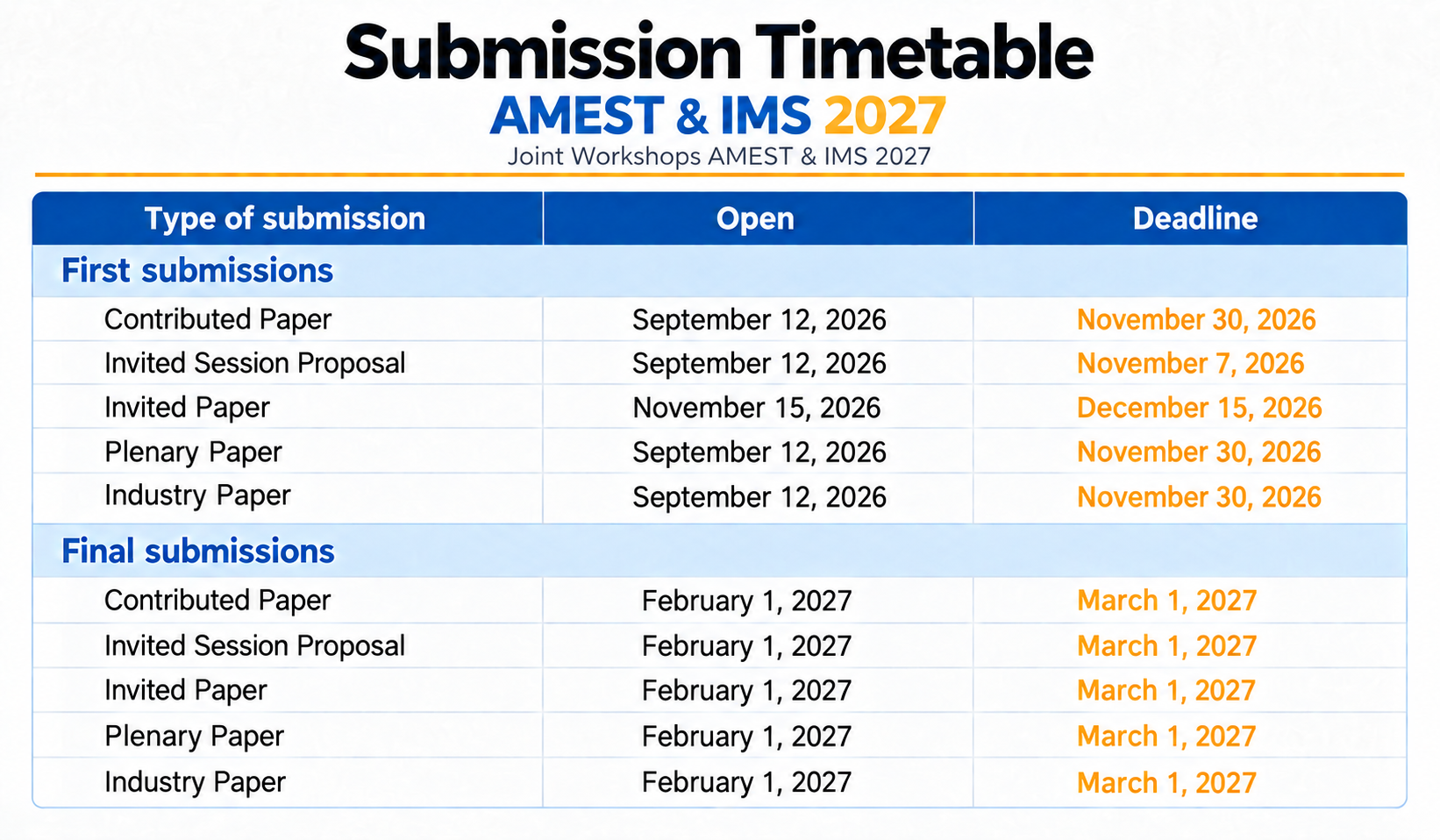
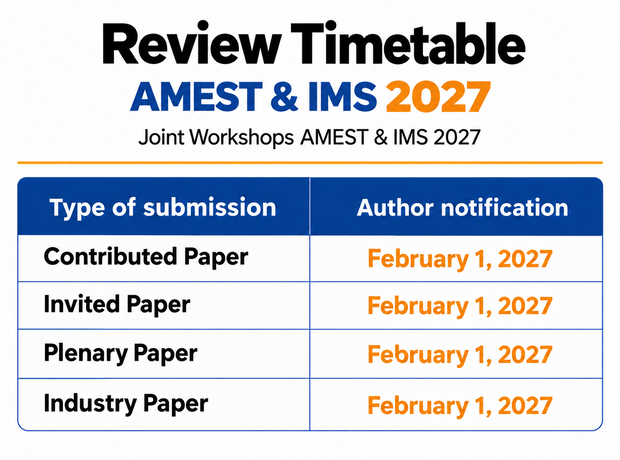
Timetables
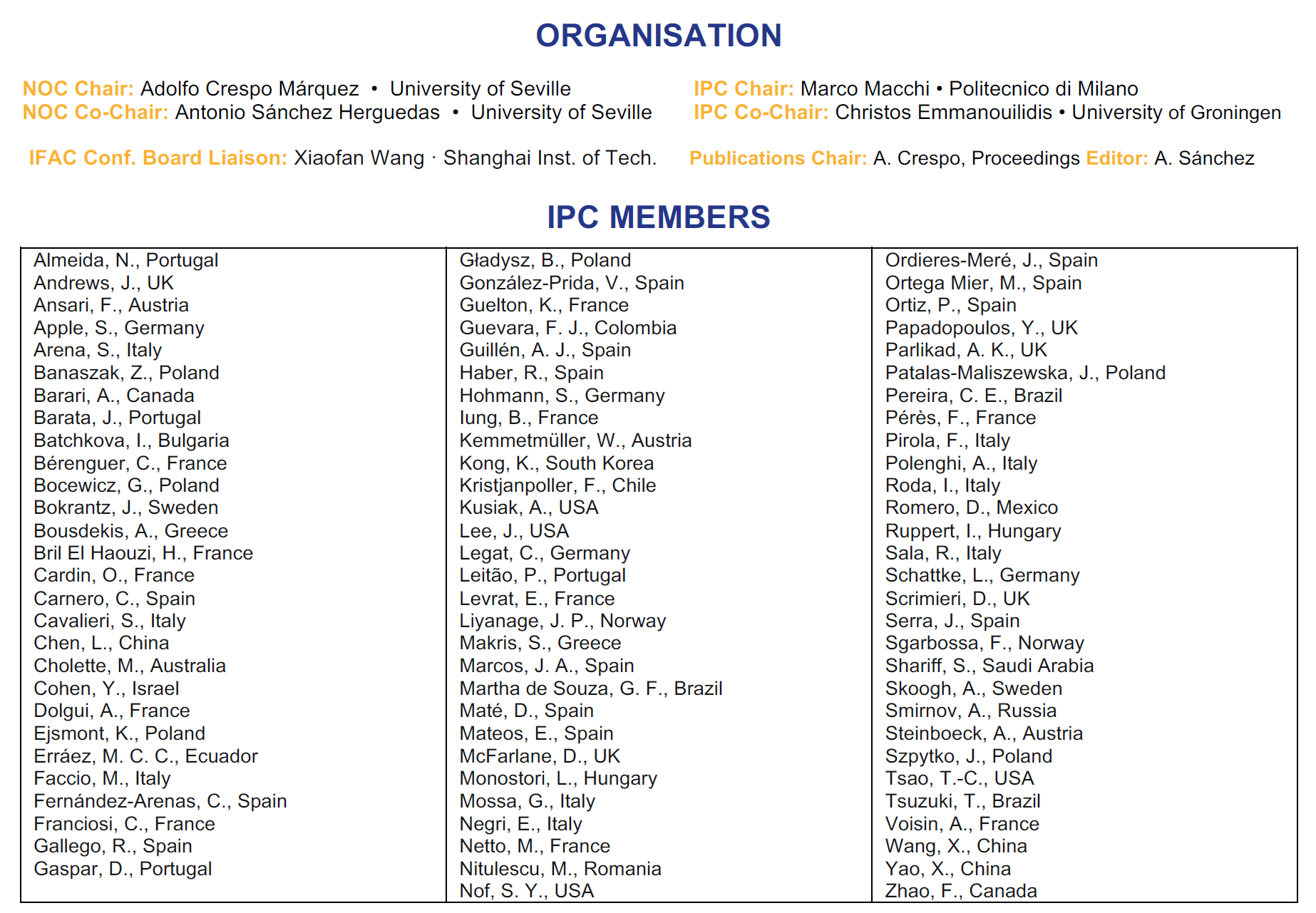
Organisation and IPC members
Copyright Conditions
The IFAC copyright conditions, as revised in November 2019, are given below:
“All publication material submitted for presentation at an IFAC-sponsored meeting (Congress, Symposium, Conference, Workshop) must be original and hence cannot be already published, nor can it be under review elsewhere. The authors take responsibility for the material that has been submitted. IFAC-sponsored conferences will abide by the highest standard of ethical behaviour in the review process as explained on the Elsevier webpage (https://www.elsevier.com/authors/journal-authors/policies-and-ethics), and the authors will abide by the IFAC publication ethics guidelines.
Accepted papers that have been presented at an IFAC meeting will be published in the proceedings of the event using the open-access IFAC-PapersOnLine series hosted on ScienceDirect (https://sciencedirect.com/). To this end, the author(s) must grant exclusive publishing rights to IFAC under a Creative Commons license when they submit the final version of the paper. The copyright belongs to the authors, who have the right to share the paper in the same terms allowed by the end user license, and retain all patent, trademark and other intellectual property rights (including research data).”
Cancellation and Refund Policy
Two communities. One joint forum.
One shared vision
For intelligent, resilient and human-centered industrial systems.